AI Automation & Business OS Program 2026–2027 — learn to build an AI-powered business operating system

Live online course · Batch 2026–2027 · Enrolment open

Don't just learn AI. Make AI work for you.

A 3-month, project-based AI & Automation course where you don't study tools — you build with them. Under a mentor's guidance, you design and automate real business systems: something that helps your business, and something that builds your career.

  • 3-month practical program
  • 45–55 live sessions
  • Project-based learning
  • Outcome-driven

Course fee · Batch 2026–2027

₹49,999₹29,999+ 18% GST

Limited-period learner offer — you save ₹20,000. 3 months · 15 modules · 45–55 live sessions · capstone included.

Chandan Maheshwari — founder of School of AI & AIVIO Intelligence, business coach and lead mentor of the AI Automation & Business OS Program

Your mentor

Chandan Maheshwari

Founder, School of AI & AIVIO Intelligence · Business coach

16 years of experience · mentored 1,500+ business owners & professionals. Teaches you live, builds alongside you, and reviews every project you ship.

16 yrs experience1,500+ mentoredLive teachingProject reviews

Who this is for

Only for serious and curious AI learners.

If you are genuinely serious about entering the AI vertical — not just collecting tool names, but learning to build and operate AI-powered business systems — this program is designed for you.

Students

Build real systems, not just tool tutorials. Graduate with a portfolio that shows business impact.

Working Professionals

Stop competing with AI. Learn to redesign work around it and become the person who applies AI at work.

Business Owners

Turn scattered tools and manual work into connected, documented business systems that scale.

Curious AI Learners

Move beyond surface-level AI tools. Understand the architecture, build the system, see it run.

Not sure if you fit? Ask us on WhatsApp — we will give you a straight answer.

The real problem

Your business is already generating data. The problem is that it is scattered.

Most businesses do not suffer from a lack of data. They suffer from disconnected data, disconnected processes and disconnected communication.

Scattered information

  • Website
  • WhatsApp
  • Email
  • Social media
  • Forms
  • Spreadsheets
  • CRM
  • Documents
  • Customer chats
  • Sales activity
  • Operations
  • HR
  • Finance
  • Support

What it costs the business

  • Duplicate work
  • Manual data entry
  • Delayed responses
  • Lost leads
  • Poor follow-up
  • Operational bottlenecks
  • Information silos
  • Reporting delays
  • Decision bottlenecks
  • Higher operating costs

Connected business data

  • One customer record

    Customer → conversations → leads → orders → support

  • One process library

    Trigger → data → decision → action → follow-up

  • One intelligence layer

    AI reads, classifies, extracts and recommends

  • One visibility layer

    Dashboards, KPIs, alerts and exceptions

The Business OS changes the architecture — not just the tools.

Stop running your business through disconnected tools, spreadsheets, conversations and people's memory.

Talk to Us About Your Business

The core concept

What is an AI-powered Business Operating System?

Instead of isolated tools for different parts of the business, a Business OS is a connected operating layer where information moves across departments and processes. Select a layer to see what it does.

Business Outcomes

AI Intelligence

AI as the intelligence layer inside processes: reading documents and conversations, judging intent and urgency, drafting responses, suggesting next actions.

  • Understand
  • Classify
  • Extract
  • Reason
  • Generate
  • Recommend

The shift: tool-centric → system-centric

A channel is only an entry point. An AI model is only an intelligence layer. An automation platform is only an execution layer. The value appears when these work together around real business processes and data.

Discuss Your AI Automation Opportunities

The journey

From learning AI to running an AI-powered Business OS.

One path, eight moves, three months. Each step builds on the one before it — you finish with a working system, not a certificate of attendance alone.
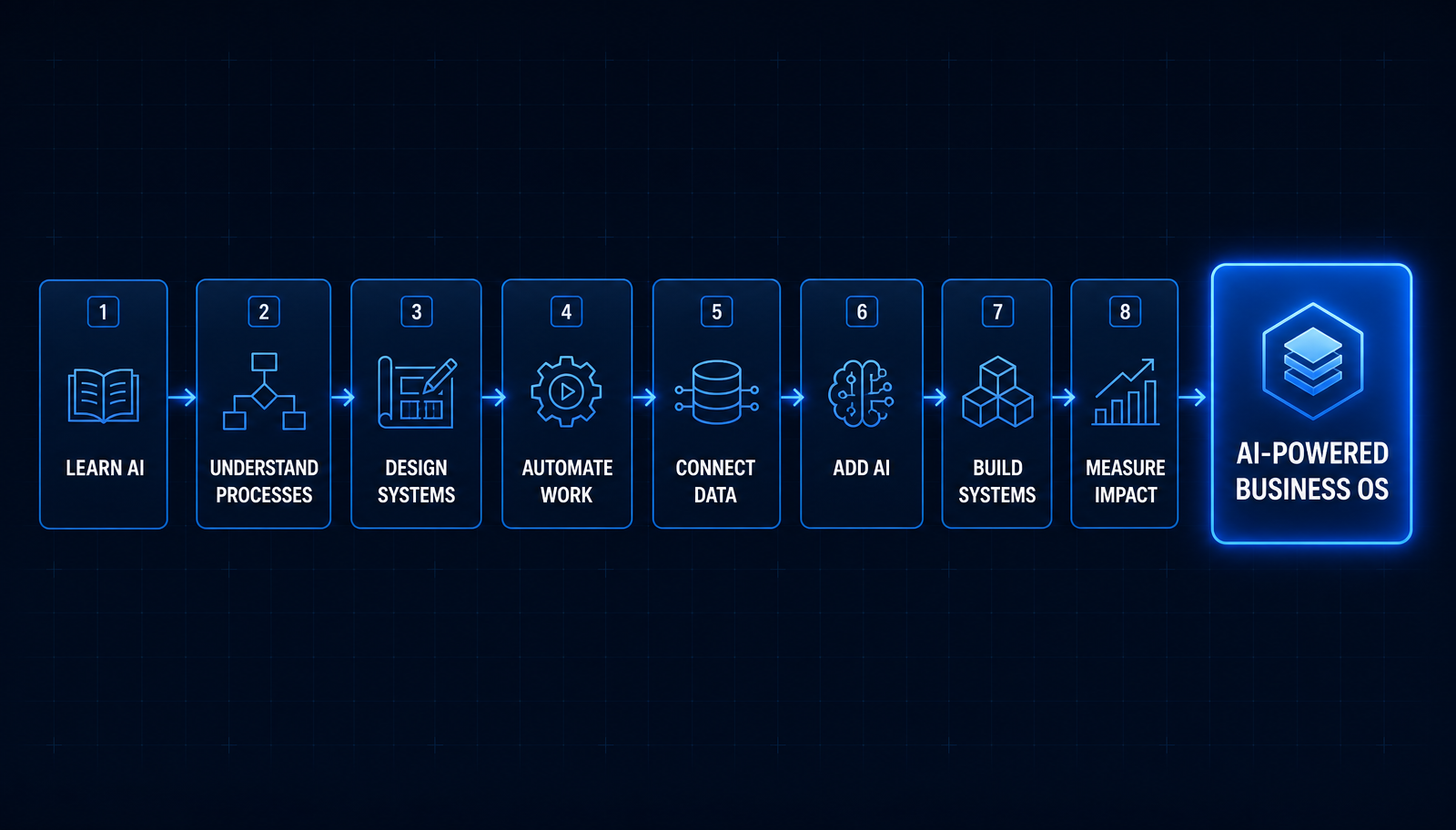
The program journey: learn AI, understand processes, design systems, automate work, connect data, add AI, build systems, measure impact — leading to an AI-powered Business OS.
The eight-step path every learner walks, ending in an AI-powered Business Operating System.

Month 1

Understand + Design

  • AI foundations for business
  • Business mapping & process engineering
  • Business data architecture
  • Your Business OS blueprint

Month 2

Build + Automate

  • CRM & business data systems
  • AI workflows that take real actions
  • Chatbots and task-oriented agents
  • Cross-functional automation

Month 3

Integrate + Optimize

  • Communication systems (WhatsApp, email, voice)
  • Dashboards & KPIs
  • AI-native internal applications
  • Capstone Business OS + impact model

Approx. 45–55 live sessions · 3 sessions a week · 60 minutes each. In three months you gain the architecture and capability to start building a CRM/ERP-like Business OS — we do not claim a universal ERP in 90 days.

Ask About the Schedule

Hands-on output

What will you actually build?

The program is designed around systems rather than isolated demonstrations. By the later stages, individual capabilities are connected into one business architecture.

01

Business CRM

Structured leads, contacts, companies, opportunities, activities and follow-ups.

Customers stop living in spreadsheets, chats and individual memory.

Faster response, consistent follow-up, visible pipeline

02

Business Data System

A connected place for records, documents, conversations and operational information.

Every workflow and every AI step needs reliable business context.

Capture once, reuse everywhere

03

AI Workflows

Multi-step processes where AI understands information and triggers the next action.

AI becomes part of the process instead of a separate chat window.

Less manual processing, fewer delays

04

AI Chatbots

Conversational interfaces connected to knowledge, data and business actions.

Customers get answers with context, not scripted replies.

Lower support load, better experience

05

AI Agents

Task-oriented systems using knowledge, tools and defined actions with human escalation.

Some work needs judgement and steps, not a single answer.

More execution capacity per person

06

Communication Systems

Website, WhatsApp, email, social and voice connected to the Business OS.

Channels are entry points into the business, not separate islands.

Context-aware responses, nothing lost

07

Departmental Automation

Sales, marketing, operations, HR, finance and support workflows on shared data.

Departments share the same records and logic.

Fewer handoffs, less rework

08

Intelligent Dashboards

KPIs, operational status, workload, exceptions and AI-generated insights.

Management should see the business, not assemble reports.

Faster decisions, earlier interventions

09

AI-Native Applications

Internal tools, portals, forms and approval systems people actually use.

A system only works if the team can operate it.

Standardised process execution

10

End-to-End Business OS

A connected prototype built around a real business problem.

The architecture is proven on a real process, with a real metric.

A measurable before → after

You will not finish with a generic product that magically runs every business. You finish able to design, build, connect and improve a Business OS around the processes, data and economics of a real business.

Ask What You'd Build

How it works

One repeatable pattern behind almost every business process

Most business use cases decompose into the same system pattern. Learning the pattern makes the capability transferable across industries.

01

Capture

An enquiry, document, message, call or internal request arrives.

02

Understand

AI reads it and identifies intent, category and urgency.

03

Structure

Unstructured information becomes a business record.

04

Decide

Rules and AI reasoning choose the path: qualify, route or escalate.

05

Act

The system updates records, assigns tasks and raises approvals.

06

Communicate

The right response goes out on the right channel.

07

Record

Every activity is written back to the connected data layer.

08

Measure

Response, cycle time, conversion and cost are tracked.

09

Improve

Bottlenecks are found and the process is redesigned.

Worked example · inbound enquiry

One message, one connected flow

  1. Customer sends an enquiry

  2. AI understands the intent

  3. Business data is retrieved

  4. Lead is qualified

  5. CRM is updated

  6. Follow-up is triggered

  7. Customer receives a response

  8. Sales team gets the right context

  9. Management dashboard updates

  10. Performance can be measured

Human oversight and exception handling stay part of the design — the system escalates what it should not decide alone.

Practical use-case library

What problems can you solve with this?

Fifteen end-to-end flows from the curriculum. Each one is a small Business OS: capture, understand, structure, decide, act, communicate, record, measure.

AI Sales Agent

  1. Enquiry
  2. Conversation
  3. Qualification
  4. CRM
  5. Follow-up

Voice Calling Agent

  1. Call
  2. Understand
  3. Respond
  4. CRM
  5. Escalate

WhatsApp Lead Flow

  1. Message
  2. Intent
  3. AI
  4. CRM
  5. Action

Customer Support Bot

  1. Question
  2. Knowledge
  3. Answer
  4. Human handoff

Content Engine

  1. Idea
  2. Research
  3. Content
  4. Repurpose
  5. Schedule
  6. Measure

Marketing Nurture

  1. Lead
  2. Segmentation
  3. Personalised outreach
  4. Follow-up

Operations Workflow

  1. Trigger
  2. AI / logic
  3. Data
  4. Approval
  5. Completion

HR Screening

  1. Application
  2. AI analysis
  3. Structured data
  4. HR review

Document Processing

  1. Document
  2. Extraction
  3. Structured record
  4. Notification

Business CRM

  1. Lead / deal
  2. AI enrichment
  3. Workflow
  4. Reporting

Internal AI Assistant

  1. Knowledge
  2. Employee question
  3. AI
  4. Action

KPI Automation

  1. Bottleneck
  2. KPI
  3. Intervention
  4. Measurement

Approval System

  1. Request
  2. Validation
  3. Decision
  4. Approval
  5. Audit trail

Customer Reactivation

  1. Dormant customer
  2. Segmentation
  3. Outreach
  4. CRM update

Management Briefing

  1. Business data
  2. AI analysis
  3. Exceptions
  4. Summary

Not sure which of these fits your business or role? Ask — we'll be specific.

Talk to an AI Program Advisor

Business impact

What does this actually do for a business?

Automation is not successful simply because a workflow runs. It is successful when it improves an economically meaningful business metric.

Save Time

  • Reduce repetitive work
  • Reduce manual data entry
  • Reduce searching for information
  • Reduce routine follow-up
  • Reduce repetitive reporting

Measure: Hours of manual work removed · cycle time · response time

Save Money

  • Reduce operational friction
  • Reduce rework and duplication
  • Reduce avoidable errors
  • Improve process efficiency

Measure: Cost per process · overtime · rework cost

Generate More Revenue

  • Improve speed-to-lead
  • Improve qualification
  • Improve follow-up consistency
  • Improve nurturing
  • Increase sales execution capacity

Measure: Leads · conversion · revenue per lead · sales cycle

Increase Profitability

  • Improve productivity
  • Reduce unnecessary operating effort
  • Increase output from existing capacity

Measure: Gross profit · operating profit · contribution per process

Improve Margins

  • Combine efficiency gains with revenue improvement
  • Grow output without proportional cost

Measure: Gross margin · contribution margin · cost-to-revenue ratio

The program is designed to help businesses identify and capture these opportunities. It does not promise a fixed percentage of savings or revenue growth. Actual impact depends on the business, process volume, labour cost, conversion economics, data quality, implementation quality and adoption — so you learn to measure the baseline, model the opportunity and validate the result.

Impact model

Think about automation economically, before you build anything

This is the same baseline model taught in the program: measure the current process, estimate the opportunity, then validate the realised result.

Repetitive work today

5
1 hrs
22
300

Revenue side (optional)

200
8 %
2 pp
5,000

Illustrative opportunity estimate

Manual hours / month

110 hrs

Capacity value / month

₹33,000

Current deals / month

16.0

Additional deals / month

4.0

Combined monthly opportunity

₹53,000

Released capacity value + potential incremental contribution

Illustrative opportunity estimate — not a guarantee. Released time only becomes profit when the business redeploys that capacity into higher-value work. Use your own process volume, labour economics and outcome data.

Discuss Your Business Case

Intelligent management

Don't just automate the business. Understand the business.

Once business data is structured and connected, the Business OS becomes a management visibility layer: data → information → insight → action.

Business OS · management dashboard

Illustrative interface — figures are examples, not results.

Connected data

Open leads

1,284

Sales queue

Conversion

12.4%

Qualified → won

Support queue

37

Awaiting response

Pending tasks

112

Across departments

Approvals waiting

9

Finance & ops

Manual hours removed

186

This month

Workload / automation trend

Automated executions rising as manual handling falls.

AI insights & actions

  • Response time on WhatsApp enquiries is the current bottleneck.
  • 24 qualified leads have had no follow-up activity for 5+ days.
  • Invoice extraction is the highest-volume manual process this month.
  • Support escalations are concentrated in one product category.
Illustrative management dashboard for an AI-powered Business Operating System.
Dashboard layerQuestionExamples
Operational visibilityWhat is happening right now?Open leads, support queue, approvals, overdue tasks
Performance visibilityHow are we performing?Conversion, response time, throughput, productivity
Financial visibilityWhat is the economic effect?Revenue, cost, contribution, margin
AI insightsWhat needs attention?Priorities, anomalies, bottlenecks, next actions
Management actionWhat should happen next?Assignments, escalations, interventions

Who this is for

Same capability. Three very different reasons to build it.

Turn your business processes into systems.

Stop running your business through disconnected tools, spreadsheets, conversations and people's memory.

Where you are now

  • Too much manual and repetitive work
  • Data scattered across places
  • Leads lost, follow-up inconsistent
  • Departments operating in silos
  • Dependence on individuals
  • Poor management visibility
  • Rising operating costs
  • Hard to scale without adding manpower

What you develop

  • Save time and reduce manual work
  • Connect business data
  • Improve lead response and follow-up
  • Automate departmental processes
  • Improve management visibility
  • Build scalable, documented systems
  • Identify revenue opportunities
  • Improve profitability and margins

Why this is different

From knowing AI to knowing how to use AI inside a business.

Tools are not the product. The capability is the product.

Traditional AI course

  • Learn tools
  • Learn prompts
  • Watch demonstrations
  • Build small examples
  • Focus on features
  • Isolated automations
  • AI as a standalone chatbot
  • Blind full automation
  • Automation for its own sake
  • Dependence on one platform
  • A promise of a universal ERP

AI Automation + Business OS Program

  • Understand the business first
  • Map processes and decisions
  • Build systems hands-on
  • Connect business data
  • Introduce AI where it pays
  • Automate execution end to end
  • AI inside business processes
  • Human + AI + automation
  • Measurement and KPI thinking
  • Transferable system principles
  • A starting point for a Business OS

The learning philosophy

Every build begins with a business problem and ends with a measurable outcome.

01

Understand

Understand the problem, the process and the economics.

02

Design

Design the process and the data before choosing tools.

03

Build

Build the system: records, screens, workflows.

04

Automate

Automate the repetitive work, keep human judgement.

05

Integrate

Integrate the components into one operating flow.

06

Optimize

Optimize against a business outcome, then repeat.

Detailed curriculum

Fifteen modules, one connected system

Each module builds a part of the Business OS. Expand any module for the detail.

Delivered over approximately 45–55 live sessions — concepts, demos, guided building, exercises and troubleshooting.

Request the Full Curriculum

Capstone

Your final project: build a Business OS around a real problem.

The capstone proves you can move from business understanding to system architecture, implementation and measurement.

  1. STAGE 01

    Business diagnosis

    Map departments, stakeholders, customers, processes, data and pain points.

  2. STAGE 02

    Process selection

    Choose high-value processes on time, cost, revenue, customer impact and feasibility.

  3. STAGE 03

    Baseline measurement

    Capture current processing time, manual effort, rework, response or conversion.

  4. STAGE 04

    System blueprint

    Define modules, data entities, workflows, AI touchpoints, communication, dashboards.

  5. STAGE 05

    Build priority modules

    CRM/data foundations, workflows, conversational interfaces, agents, applications.

  6. STAGE 06

    Integrate

    Connect data, automation, communication and interfaces into one end-to-end flow.

  7. STAGE 07

    Add intelligence

    AI for understanding, extraction, reasoning, generation and prioritisation.

  8. STAGE 08

    Automate

    Execute real business actions with controlled exceptions and human oversight.

  9. STAGE 09

    Measure

    Compare the new process against the baseline and identify realised impact.

  10. STAGE 10

    Present

    Show before → after architecture, business value, human steps and roadmap.

What a strong capstone demonstrates

  • A clear business problem, not a technology demonstration
  • A mapped current-state and a defined future-state process
  • Structured business data and connected records
  • At least one meaningful AI-enabled workflow
  • At least one automation that executes a real business action
  • A communication or user interface connected to the flow
  • A KPI or economic metric the system is designed to improve
  • A clear explanation of human oversight and exception handling
Talk About Your Capstone Idea
Chandan Maheshwari, founder of School of AI & AIVIO Intelligence and lead mentor of the AI Automation & Business OS Program

Who teaches you

Chandan Maheshwari

Founder, School of AI & AIVIO Intelligence · Business coach · Lead mentor

With 16 years of experience and 1,500+ business owners & professionals mentored, Chandan leads every session live — concepts, demos, guided building, exercises and troubleshooting on your own business problem. You are not handed recordings and left alone; you build alongside a mentor who reviews your Business OS blueprint and your capstone.

16+

Years of experience

1,500+

Owners & professionals mentored

2

Companies founded

  • Business deconstruction & process engineering
  • Business data architecture and CRM design
  • AI workflows, chatbots, agents and voice
  • Dashboards, KPIs and impact measurement

In their words

What business owners take away from the program.

Feedback shared by participants about the learning experience — not a promise of business results.

I came in thinking I would learn a few AI tools. I left with a map of my own business — where the work actually gets stuck, and which of those steps a system can take over.

Rohit Agarwal

Owner, building materials trading · Jaipur

The part that changed things for me was data. Once my leads, conversations and follow-ups sat in one place, my team stopped asking me for status updates every morning.

Sneha Iyer

Founder, interior design studio · Bengaluru

We built a WhatsApp enquiry flow during the sessions itself. Watching an enquiry come in, get qualified and land in the CRM without anyone touching it was the moment it clicked.

Amit Deshpande

Director, industrial components · Pune

It is taught like a business programme, not a coding class. I could follow every session and still walk out with something working for my own operations.

Priya Nair

Co-founder, wellness clinics · Kochi

The dashboard module was worth the fee on its own. For the first time I see my numbers without waiting for someone to prepare a sheet.

Vikram Singh

Managing Partner, logistics · Delhi NCR

What I appreciated most was the honesty. No promises of magic results — just a clear method to measure what the system actually saves.

Meera Shah

Owner, apparel manufacturing · Surat

Program investment

A curious-learner offer, while it lasts.

The program fee is ₹49,999 + 18% GST. Because you came looking for this — genuinely curious about where AI meets real business systems — you can join at the current offer price and keep ₹20,000 in your pocket.

  • 15 modules across 3 months
  • Approx. 45–55 live sessions (3/week, 60 min)
  • Live mentoring by Chandan Maheshwari
  • Guided building, exercises and troubleshooting
  • CRM, workflows, chatbots, agents and dashboards
  • Business OS blueprint and impact model
  • Capstone Business OS with before → after measurement
  • Certificate of completion after the capstone
Save ₹20,000Limited-period learner offer

₹49,999

₹29,999

+ 18% GST · full 3-month program, all 15 modules, capstone included.

Program fee

₹49,999

Your price

₹29,999

You benefit

₹20,000

No placement, salary or revenue guarantees. What you get is the curriculum, the architecture and the practical capability — plus straight answers before you enrol. Once enrolled, the fee is non-refundable, so please ask us everything first.

How to enrol

01

Message us on WhatsApp

Tell us your business or career goal.

02

Short clarity call

We confirm the program fits what you want to build.

03

Confirm your seat

Pay the fee and receive the batch schedule and onboarding.

Refund policy: we do not issue refunds once a student is enrolled. Every question is welcome before you join — that is what the WhatsApp line is for.

FAQ

Straight answers before you enquire

Grounded in the program curriculum — no invented outcomes, no guarantees.

Next step

Your business is already producing data. The next step is making it work for you.

Learn how to understand your business, connect its data, redesign its processes, introduce AI, automate execution and start building the systems that make the business faster, more efficient and more scalable.

Talk to Us on WhatsApp